How to read a building programme
A building programme is more useful than a list of dates. It should explain the order of work and what must happen before a later activity can start. If you can see the dependencies, you can ask better questions when a date moves.
Start with the milestones
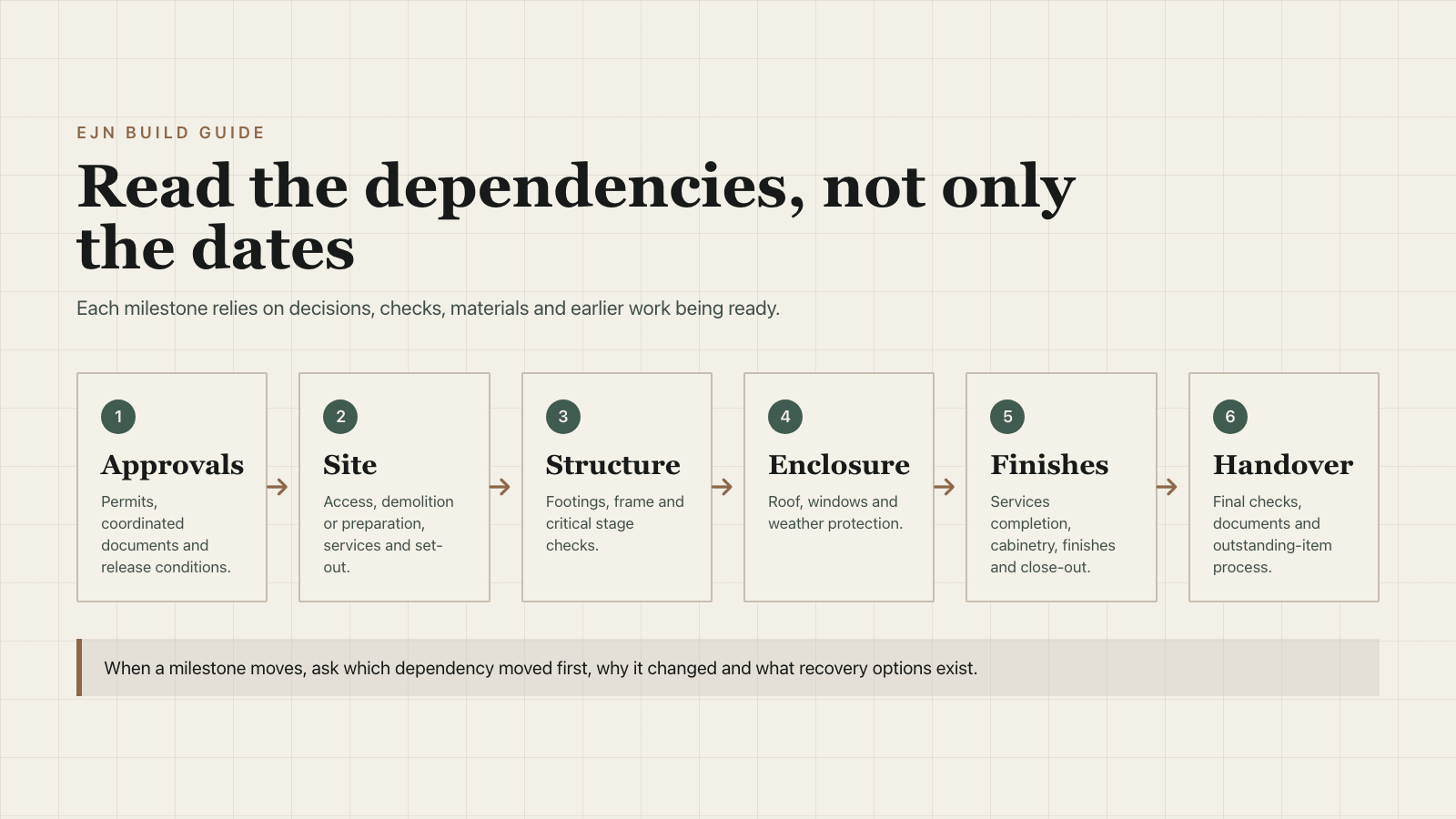
Look for the main stages: approvals, site start, structural work, enclosure, services, finishes, inspections and handover. A programme may show more detail, but these milestones help you orient yourself. Ask what event marks each stage as complete. “Frame complete” and “frame ready for the next trade” can mean different things if a check or correction is still open.
Follow the dependencies
Some work can overlap; other tasks must follow a strict sequence. An item with several downstream activities can affect the entire project if it slips. This is why the critical path matters. It shows the chain of work that currently governs the earliest plausible finish. The critical path can change as decisions, site conditions and supply dates change, so it is not a permanent label attached to one trade.
Separate time from certainty
A date can be a confirmed booking, an estimate or an assumption. Ask which it is. Selections, long-lead materials, permit conditions and client decisions may sit outside the direct control of the on-site team. A good programme names those inputs and shows when each is needed. It should also show when the programmer was last updated, so you are not reading a schedule that has already been overtaken by events.
Ask what changed and why
When a milestone moves, compare the current revision with the previous one. Which activity moved first? What new information changed the sequence? What options exist to recover time, and what would each option cost or risk? The answer should be tied to the programme and the actual work, not a general assurance that everything is on track.
EJN Build uses a live programme to make the dependencies visible to the project team. It works alongside stage records and written variations: a design change can affect procurement, a hold point can affect the next trade, and both should be reflected in the schedule. Ask us how your project would be programmed, or explore our approach to new homes and renovations.
