How to compare custom home quotes: why the total is the last thing you should look at
Establish What Each Quote Was Based On
Build a Side-by-Side Scope Sheet
Ask About the Differences Before Drawing Conclusions
The natural instinct when comparing quotes for a custom home is to look at the total figures and rank them. The lowest number looks like the best value. The highest looks like the most expensive option. The ones in the middle get compared against each other on the assumption that they are roughly describing the same thing.
The problem with this approach is that custom home quotes are almost never describing exactly the same thing and the differences between them are almost never visible in the total. They are buried in the scope, in the specification, in the allowances, in the exclusions, and in the assumptions that each respondent made about what they were being asked to price.
A quote that appears significantly lower than the others may be lower because it prices a narrower scope, uses different specification assumptions, excludes items the other quotes include, or was prepared from an earlier drawing revision that does not reflect the current design. A quote that appears higher may reflect a more thorough reading of the specification, more conservative allowances for items where costs are uncertain, or a more complete scope that does not require separate coordination for excluded work.
None of these differences are visible from the total. The first task in comparing custom home quotes is understanding what each quote actually describes and that task needs to be complete before any meaning can be drawn from the figures.
Establish What Each Quote Was Based On
Before comparing any numbers, record the specific reference documents that each quote was prepared from. The drawing revision number and date, the specification version, and the project description that each respondent received should be confirmed for every quote in the comparison.
This step matters more than it might initially seem. In a custom home project, design documentation evolves during the tender period and even a minor revision to the drawings can change what some respondents priced. If one builder received an updated drawing that increased the floor area, or a revised specification that changed a finishes allowance, and another priced from the earlier version, their totals are not comparable without adjusting for that difference. The comparison will appear to show a price difference between the two respondents when it is actually showing a scope difference between two sets of documents.
Where a respondent has made assumptions about something that was not specified in the documents, a service connection, a particular product specification, a site access arrangement, record what they assumed, not just what they quoted. An assumption that works in the builder’s favour is a risk that may transfer to the homeowner when the actual condition is different from what was assumed.
Build a Side-by-Side Scope Sheet
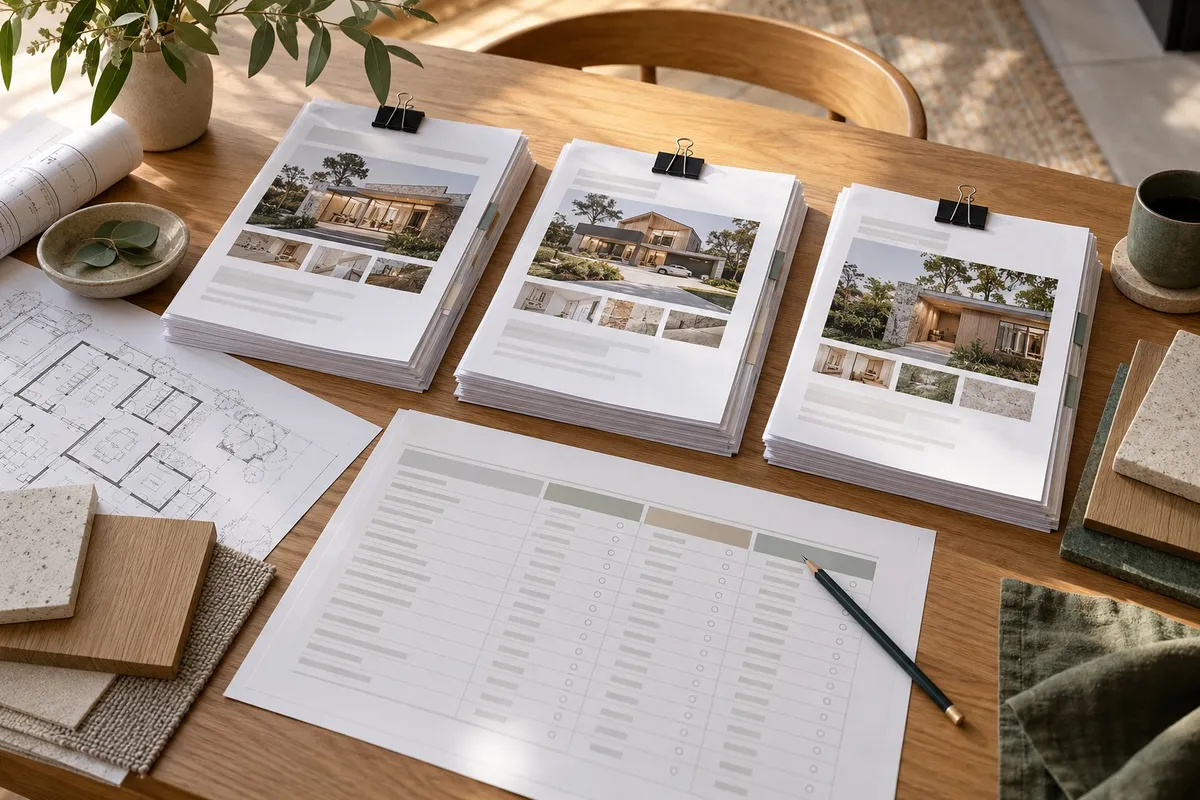
A scope sheet that compares what each quote covers using plain language descriptions rather than the respondents’ own pricing language, is the tool that makes a meaningful comparison possible.
The scope sheet should list each element of the project as a row, with a column for each respondent. For each element and each respondent, the entry should record what the quote covers, what it excludes, and what is covered by an allowance or provisional sum rather than a fixed price. This structure makes it immediately visible when two respondents have priced the same element differently or when one has included something the other has not.
Keep the original quote documents available alongside the scope sheet, because the summary will inevitably simplify some of the language the respondents used. The original wording matters when a clarification is needed, a qualification that appears in the quote may have contractual significance that a plain-language summary does not preserve. Do not allow the comparison sheet to replace the original documents; allow it to navigate them.
Where an element of the scope sheet is blank for one respondent where an item appears in one quote but not another, mark it explicitly as missing rather than assuming it is included at zero cost. An item not mentioned in a quote may have been excluded, may have been overlooked, or may have been absorbed into a different line item. The only way to know which of these is true is to ask the respondent directly and get the answer in writing.
Ask About the Differences Before Drawing Conclusions
Every significant difference between quotes whether in total, in scope, or in the treatment of a specific element, deserves a question before it is treated as meaningful information.
An unexplained difference is not a bargain or an error. It is an unanswered question. A quote that is substantially lower than the others on a particular item may reflect a genuine efficiency, a different product specification, a different approach to the work, or a scope gap that will need to be resolved during the project if it is not resolved during the comparison. Treating it as evidence that the other respondents are overpriced before understanding what it reflects is a decision made on incomplete information.
Five questions provide a useful structure for working through the differences with each respondent.
Does each quote cover the same work and documentation? This is the foundational question and the answer establishes whether a comparison is even valid at the total level before the detail is examined. If the answer is no, the first step is adjusting the comparison to reflect the same scope, or understanding why the scopes differ.
Which allowances or provisional items need explanation? Allowances and provisional sums are the parts of a quote where the final cost is not fixed where the respondent has used a placeholder rather than a confirmed price because the information needed to price the item accurately is not yet available. Understanding what each allowance covers, how it was arrived at, and what the likely range of outcomes is gives a clearer picture of the actual cost range the quote represents than the total figure alone.
What exclusions could require separate coordination? An exclusion from one builder’s quote is not necessarily an item the homeowner will avoid paying for, it may be an item that needs to be separately contracted with another party, or that will be added back to the contract later. Understanding what each quote excludes, and what the path to covering the excluded work is, affects the total cost of the project rather than just the cost of the initial contract.
Are selection and substitution assumptions clear? Many custom home quotes include allowances for items fixtures, finishes, appliances where the actual product selection has not yet been made. The assumptions underlying these allowances, and the process for handling substitutions when actual selections differ from them, should be clear in each quote. A large allowance for kitchen cabinetry that turns out to be based on a different product category from what the homeowner has in mind is not comparable to a similar allowance based on an accurate understanding of the intended specification.
What needs professional or contractual advice before agreement? Some differences between quotes, or some elements of a particular quote, will raise questions that cannot be resolved through a conversation with the respondent alone, they require advice from a lawyer familiar with domestic building contracts, a quantity surveyor, or another relevant specialist. Identifying these questions during the comparison process, before a contract discussion begins, allows them to be addressed as part of an informed negotiation rather than discovered after a commitment has been made.
Keep the Comparison Current as the Scope Changes
A scope comparison that was prepared at one stage of the project becomes misleading if the project changes and the comparison is not updated. A total figure left attached to a set of documents that no longer reflects the current design is information that can produce a false sense of certainty about what the project will cost.
When the scope changes when a design revision is issued, when an exclusion is resolved, when an allowance is replaced by a confirmed price, date the comparison and update all the affected entries. Note what changed, what the previous position was, and what the updated position reflects. A comparison with a clear version history is a document the project team can rely on. A comparison that has been informally updated without any record of what changed is a document that may be inconsistent in ways that nobody has noticed.
The comparison is a preparation tool, it helps the homeowner prepare for an informed discussion with their advisors and with the respondents. It does not replace contract review by a qualified professional, and it does not establish that any particular quote is suitable for the project. The comparison shows what each quote describes and how the descriptions differ. The assessment of which contract to enter into, and on what terms, is a decision that requires current professional advice specific to the project.
A Note on the Scope of This Article
This article describes an approach to comparing custom home quotes that makes the scope, the assumptions, and the differences between them visible before a contract decision is made. It does not assess the suitability of any particular quote or contract, and it does not provide legal or contractual advice.
For guidance on building contracts in Victoria including your rights and responsibilities as a building owner, Consumer Affairs Victoria publishes practical information at consumer.vic.gov.au.
EJN Build works with homeowners in South East Melbourne who are planning custom home projects. If you have questions about how to prepare for a builder selection conversation, or about what to look for when comparing quotes for a custom home, we would be glad to discuss what that looks like in practice.
